Justitia
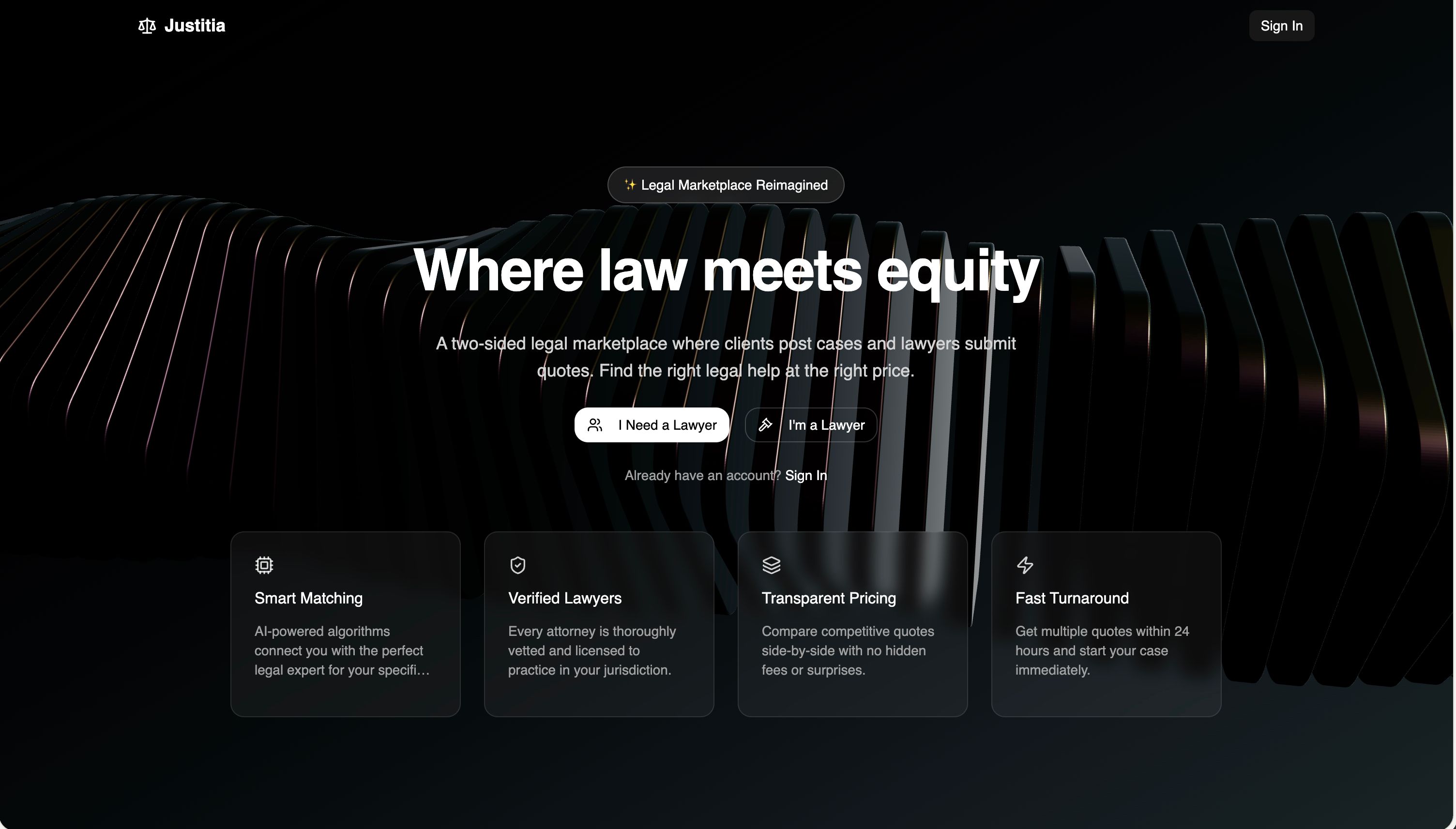
I built a legal marketplace in 3 days. Not because I had a burning passion for law (I don't), but because I kept seeing this problem: clients don't know how much legal services cost until they've already paid for a consultation. Lawyers, on the other hand, waste time on intake calls for cases they don't want.
So I built Justitia, a platform where clients post cases, lawyers bid on them, and payment happens upfront through Stripe. Simple concept. Messy execution. Here's how it went.
Except it wasn't simple. At all. So I thought: What if clients posted cases and lawyers bid on them?
The Idea:
- Reverse the flow: client posts case → lawyers compete with quotes → client picks one
- Transparent pricing, no surprises
- Like Upwork, but for legal work. Transparent pricing. No surprises. Simple.
The Stack (Why I Chose This Over Next.js)
Everyone defaults to Next.js + Prisma these days. I went different:- React Router v7 instead of Next.js. Vite-based, simpler deploy, no magic
- tRPC for APIs. Type-safe, no code gen, instant autocomplete
- Hono as server. Edge-first, fast as hell, Cloudflare Workers-ready
- Supabase Postgres. Free tier, hosted, PostgREST for backup queries
- Cloudflare R2 for file storage. No egress fees
Why not Next.js?
- I wanted control over deployment (Netlify frontend + Render backend)
- tRPC + Hono = lighter, faster, no RSC complexity
- Bun made installs instant (spoiled by speed)
The Hardest Problem: Race Conditions
Here's the thing about marketplaces: timing matters. Imagine this:- Client posts a case
- Three lawyers submit quotes ($500, $300, $400)
- Client picks the $300 quote and pays
- But what if two lawyers accept at the same time?
- Multiple accepted quotes
- Case assigned to wrong lawyer
- Payment chaos
Solution: Database Transaction
await db.transaction(async (tx) => {
  const quote = await tx.query.quotes.findFirst({
    where: and(eq(quotes.id, quoteId), eq(quotes.status, 'proposed'))
  });

  if (!quote) throw new Error('Quote already accepted');

  // Accept this quote
  await tx.update(quotes)
    .set({ status: 'accepted' })
    .where(eq(quotes.id, quoteId));

  // Reject all others
  await tx.update(quotes)
    .set({ status: 'rejected' })
    .where(and(
      eq(quotes.caseId, quote.caseId),
      ne(quotes.id, quoteId)
    ));
});Stripe Webhooks: The Hidden Landmine
Stripe webhooks are great until they're not. They can:- Be sent multiple times (idempotency matters)
- Arrive out of order
- Fail silently
The Fix: Check Before Processing
const handlePaymentSuccess = async (paymentIntentId: string) => {
  const payment = await db.query.payments.findFirst({
    where: eq(payments.stripePaymentIntentId, paymentIntentId)
  });

  if (payment.status === 'succeeded') {
    console.log('Already processed, skipping');
    return; // Idempotent!
  }

  // Update quote status, case status, notify lawyer...
};/webhooks/stripeconst sig = req.headers['stripe-signature'];
const event = stripe.webhooks.constructEvent(rawBody, sig, WEBHOOK_SECRET);If signature fails → reject. No mercy.
File Security: Attorney-Client Privilege
Legal documents = sensitive. Can't just slap files on S3 with public URLs.Access Control Rules:
- Client can access their own case files
- Lawyer can ONLY access files if quote is accepted
- Everyone else gets 403
const canAccessFile = async (userId: string, fileId: string) => {
  const file = await db.query.files.findFirst({
    where: eq(files.id, fileId),
    with: { case: { with: { acceptedQuote: true } } }
  });

  if (!file) return false;
  if (file.case.clientId === userId) return true;
  if (file.case.acceptedQuote?.lawyerId === userId) return true;

  return false;
};
Files stored in Cloudflare R2 with signed URLs (expire after 1 hour). No permanent public links.
Layer 3: Deployment & Costs (The Real World)
Deployment Stack:
- Frontend: Netlify (auto-deploy from GitHub)
- Backend: Render (Docker, free tier with auto-sleep)
- Database: Supabase (always-on Postgres)
- Storage: Cloudflare R2 (CDN-backed, no egress fees)
Monthly Cost:
- $0/month on free tiers (Netlify, Render, Supabase)
- ~$7/month if you upgrade Render to always-on
- <$1/month for R2 storage (first 10GB free)
Compare that to AWS: S3 + RDS + EC2 = $50+/month easy.
Performance:
- Average API response: <100ms (Hono is fast)
- Cold start on Render free tier: ~2-3 seconds (acceptable for demo)
The Results (What I Learned)
What Worked:- tRPC type safety caught 80% of bugs at compile time
- Bun made dependency installs instant (never going back to npm)
- Cloudflare R2 = S3 without the egress fee bullshit
- Better Auth docs are sparse (had to read source code)
- Render free tier sleeps after inactivity (cold starts suck for webhooks)
- No real-time notifications (should've added WebSockets)
- Add WebSockets for live quote updates
- Use Cloudflare Workers for backend (edge-first from the start)
- Add email notifications (currently no alerts when quote is accepted)
- Website: justitia-app.netlify.app
- Github repo: https://github.com/muslimalfatih/justitia